At 10:00 AM on April 8, 2026, Bence Nanay, Professor of Philosophy at the University of Antwerp, has been invited to deliver an academic lecture titled “Towards a New Philosophy of Desire” at the Advanced Lecture Series in the School of Humanities, Tongji University. The lecture was moderated by Assistant Professor Shiwei Chen and featured commentary by Assistant Professor Jing Shang. In his presentation, Professor Nanay reflected on the methodological framework of contemporary philosophy of mind, which tends to favor belief over desire when explaining significant psychological phenomena. He then proposed a desire-centric approach to account for cognitive phenomena such as cognitive dissonance and epistemic bubbles.
Ⅰ. What is Cognitive Dissonance?
Cognitive dissonance is generally defined as an incompatibility (or inconsistency) between an agent’s cognitive states, which triggers an unpleasant feeling and leads to a change in attitude. Take initiation rituals as an example: subjects joining a group had to endure electric shocks. Research found that the more painful the shocks, the more strongly the subjects identified with the group. This occurs because if a subject suffers significant pain but does not initially identify with the group, a conflict arises between their behavior and their attitude. To resolve this negative emotional state, the subject is compelled to convince themselves of the value and attractiveness of the group.
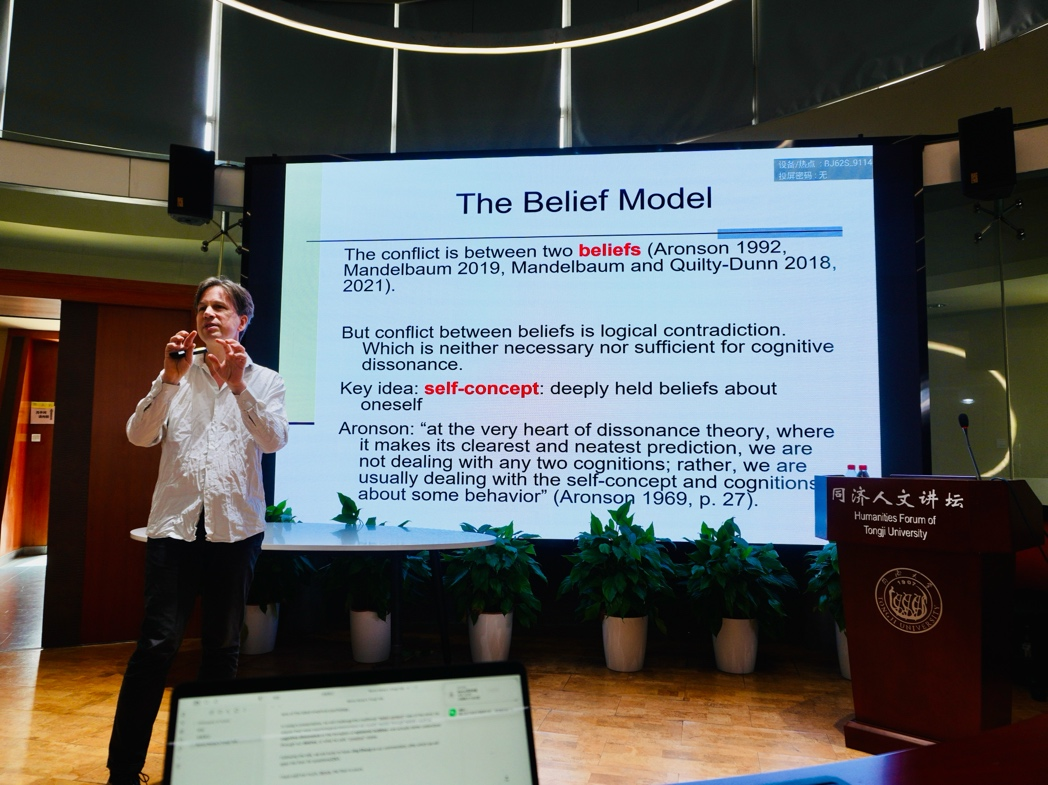
Professor Nanay argued that dissonance is not a conflict between two cognitive states but should instead be explained as a conflict between a cognitive state and a conative state. He noted that the traditional Belief Model, which assumes that two contradictory beliefs trigger dissonance, faces several theoretical difficulties.
Ⅱ. The Belief Model and Its Difficulties
The Belief Model posits that the core of dissonance theory lies in the conflict between one’s self-concept and cognitions regarding a particular behavior. Self-concept refers to deeply held core beliefs about oneself, such as being competent, kind, or resolute. While logical contradictions between ordinary beliefs rarely trigger dissonance, a contradiction between a core belief and an ordinary belief is sufficient to do so.
However, the Belief Model faces three main challenges:
1. Stability of Core Beliefs: While traditionally considered difficult to change, research by Glass (1964) suggests that core beliefs are actually quite malleable.
2. Emotional States: Beliefs themselves are affect-neutral. It is difficult to explain why a conflict between mildly charged beliefs results in a highly charged emotional state.
3. Attitude Change: The Belief Model appeals to logical contradictions within inference, but since emotions cannot participate in logical inference, it fails to explain why emotional states lead to a final change in attitude.
Consequently, Professor Nanay proposed the theory of conative dissonance to avoid these shortcomings.
Ⅲ. Conative Dissonance Theory
Conative dissonance refers to a conflict between a conative state (i.e., a desire or intentional state) and a cognitive state, which elicits an emotional reaction. Specifically, it involves a conflict between a core desire and a belief. Core desires are desires regarding oneself, such as the desire to be competent or kind.
Replacing core beliefs with core desires offers greater explanatory power:
1. Malleability: Core desires are not by definition immutable, aligning with empirical research.
2. Negative Emotions: The production of negative emotions can be explained through desire frustration. Just as wanting a coffee and failing to get it causes frustration, the frustration of a core desire leads to significant negative affect.
3. Attitude Change: When negative emotions arise, individuals often employ experiential avoidance—taking measures to change the form or frequency of these internal experiences to escape them.
Fundamentally, this theory shifts the perspective on the relationship between the mind and the world. Cognitive dissonance involves a mind-to-world direction of fit (describing the world), whereas conative dissonance involves a world-to-mind direction of fit (changing the world through action).
Ⅳ. Application: Conative Bubbles
Belief polarization occurs when two agents face the same evidence but produce opposing beliefs. The classic "epistemic bubbles" explanation—that agents lack access to evidence—is often empirically false. Another explanation, "echo chambers," suggests evidence is excluded based on unreliable sources (truth value flipping), but this is criticized for being content-insensitive.
Professor Nanay proposed the alternative concept of conative bubbles. Because agents A and B have different core desires, certain evidence may frustrate A’s desires but not B’s. Frustrated desires lead to experiential avoidance, weakening the agent's exposure to that specific evidence. This model accounts for affective polarization, where groups differ not just in belief content but in the "emotional color" attached to those beliefs. In this view, affective polarization precipitates conative polarization, which in turn leads to belief polarization.
Ⅴ. Q&A
Following the lecture, Ms. Jing Shang praised the presentation and inquired whether core desires are idiosyncratic or universally shared and socially shaped. Students raised questions about why frustrated desires sometimes strengthen and why core desires are considered easy to change given their link to self-perception. The moderator, Assistant Professor Shiwei Chen, inquired whether core beliefs and core desires carry different theoretical commitments regarding De Se (first-person) content. Professor Nanay provided detailed responses to all participants, and the lecture concluded successfully.

About Professor Bence Nanay
Professor Bence Nanay is a Professor of Philosophy and BOF Research Professor at the University of Antwerp, where he serves as the Co-director of the Centre for Philosophical Psychology. He is also the Director of the European Network for Sensory Research and was previously a Senior Research Associate at Peterhouse, University of Cambridge. Professor Nanay holds a PhD from the University of California, Berkeley, and is a leading figure in the philosophy of mind, philosophy of biology, and aesthetics. He is the author of several influential monographs published by Oxford University Press, including Between Perception and Action (2013), Aesthetics as Philosophy of Perception (2016), and Mental Imagery (2023). Notably, his work Aesthetics: A Very Short Introduction was published in a simplified Chinese translation by Yilin Press in 2023, further expanding his academic influence in the Chinese-speaking world.
Connections with Tongji University
Professor Nanay has maintained a long-standing and productive relationship with the School of Humanities at Tongji University, particularly through his involvement in the “High-end Foreign Expert Introduction Program”. This collaboration, which spans from 2023 to the end of 2024, has aimed to build a specialized research team at Tongji focused on the philosophy of cognitive science, perception, and cognitive psychology. Throughout 2024, Professor Nanay has been a frequent visiting scholar on campus, including scheduled working residencies in both April and July to engage in academic exchange and collaborative research. This partnership has not only facilitated high-level academic discussions, such as his 2023 talk on “Translucent Beliefs”, his attending to the Workshop on Philosophy of Perception at 2024, and his recent 2026 talk on “Towards a New Philosophy of Desire”, but has also laid the groundwork for joint PhD training and international forum collaborations between Tongji and the University of Antwerp.